
A MEMS-Based Magnetostrictive Hydrogen Sensor
With Sandia National Laboratories, we showed that a battery-free magnetostrictive resonator can sense hydrogen gas wirelessly, then reset itself for the next reading.
Hydrogen adds mass. Mass changes the tone.
MagTag is a magneto-acoustic resonator: a tiny magnetostrictive structure that rings at its own frequency when a magnetic field excites it, and can be read wirelessly with no battery on board.
To make it a hydrogen sensor, the resonator is coated with a thin film of palladium, a metal that can take up roughly 900 times its own volume of hydrogen. As hydrogen loads the film, the added mass lowers the resonant frequency and changes the signal amplitude. The reader sees the peak move.
A wireless hydrogen sensor that resets itself
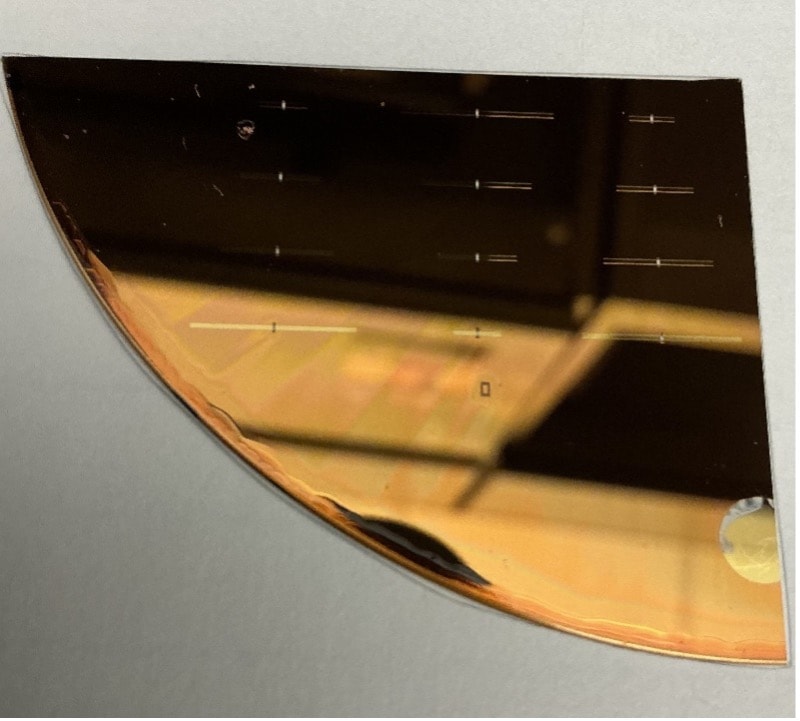
Hydrogen tests used commercial magnetostrictive strips coated with palladium, while the MEMS resonators below were fabricated in parallel for the next round of measurements.
- 3% H₂Hydrogen detectedAfter 48 hours in a 3% hydrogen atmosphere, palladium-coated tags shifted in both resonant frequency and signal amplitude.
- 2 signalsBuilt-in confirmationAmplitude and frequency move together, giving a second, independent variable that confirms hydrogen is present.
- N₂ resetReusableA nitrogen purge drove the hydrogen back out and returned the tags to their original signal.
- 50 to 300 nmTunable by film thicknessThicker palladium films also boosted signal amplitude, a possible path to longer read range.
Many resonators, one wafer
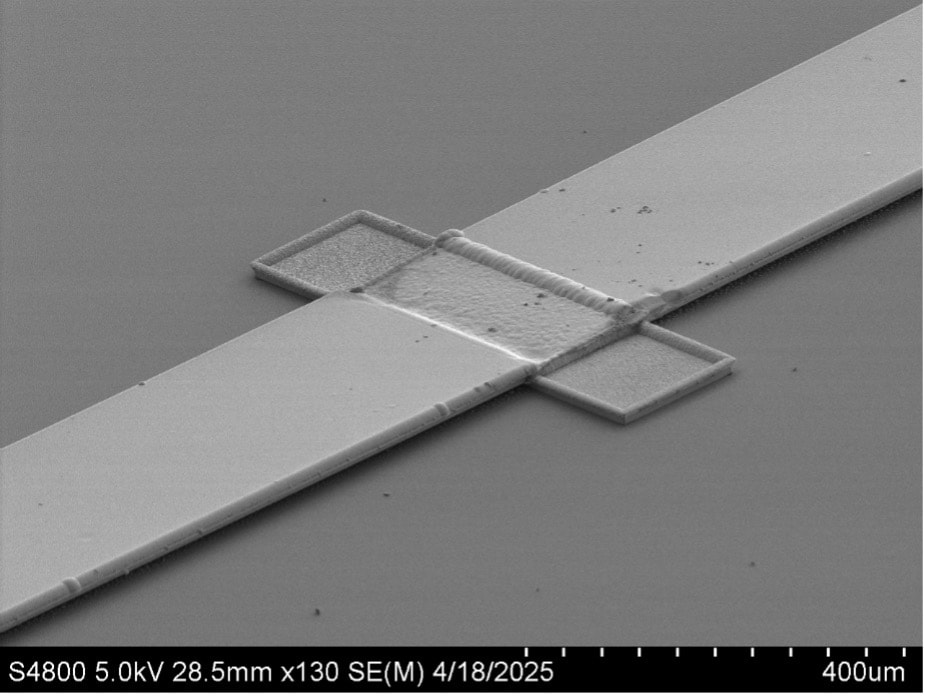
The team designed a photolithography mask with resonators of four different lengths, since a resonator’s frequency depends on its length. The magnetostrictive alloy was electroplated into the patterned molds, then released from the substrate while a center anchor keeps each one tethered.
Released resonators showed no out-of-plane bending, a sign that stress from the plating process was kept low. The result points to a single chip carrying several resonators: several sensors, plus a way to identify the chip.
Listening for the ring
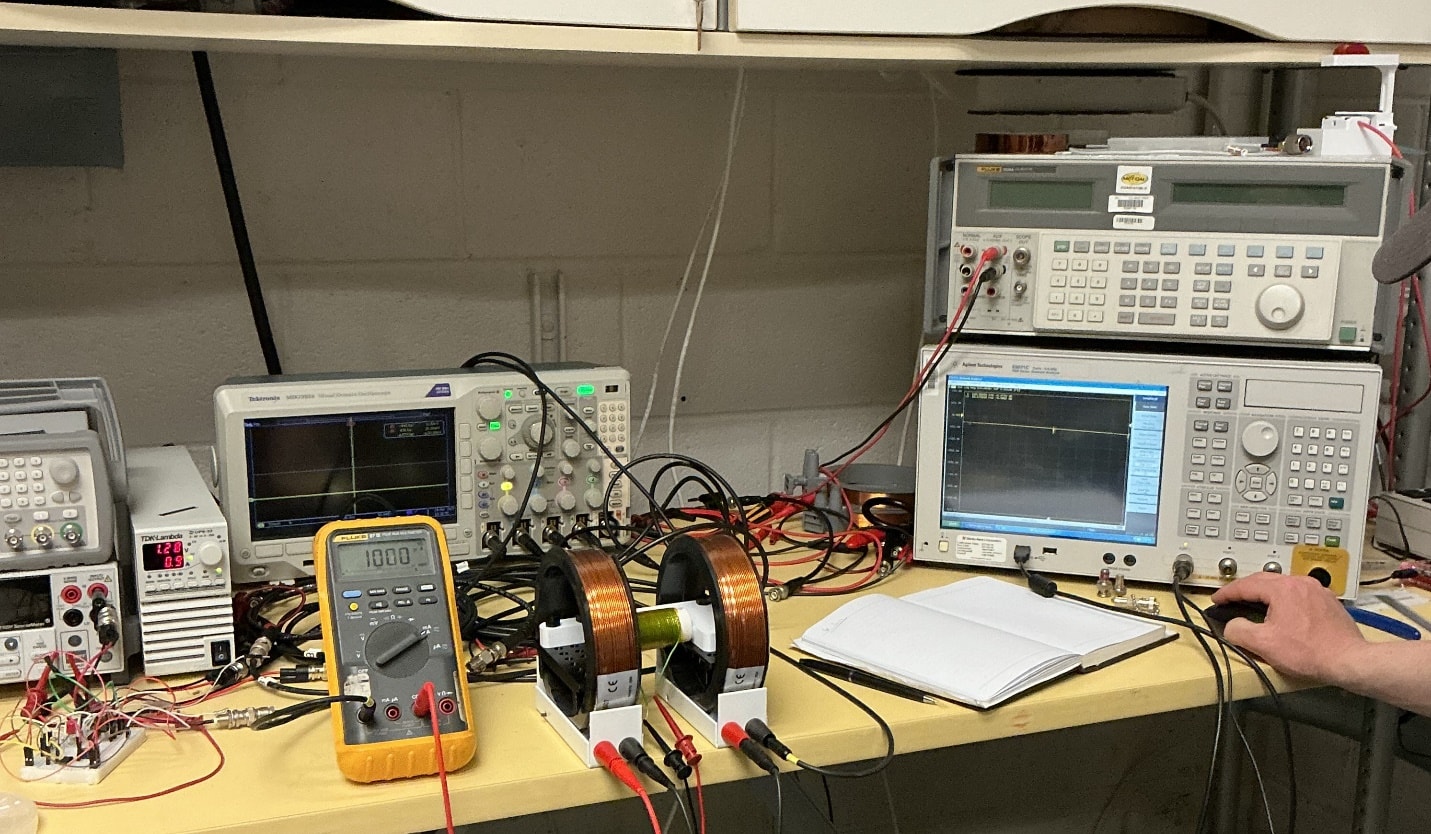
Excite a resonator and it rings like a bell, with a slow decay. The team rebuilt the test setup around a custom solenoid pickup coil and Helmholtz bias coils, then used signal processing to recover each tag’s impulse response.
Early reader electronics amplified the tag’s signal and locked onto its frequency, the first steps toward a portable device that can read tags in the field.
From a hydrogen sensor to a sensing platform
- 01
Hydrogen sulfide
The same mass-loading method, with films selective to H₂S, for oil and gas environments.
- 02
Many sensors, one chip
Separating the frequencies of multiple resonators so one chip can carry several sensors and an ID.
- 03
A portable reader
Calibrating read range against distance and geometry, toward a handheld interrogator.
Need to sense something nobody makes a sensor for?
Tell us the gas, the environment, and the constraints. We'll tell you how we'd build it.