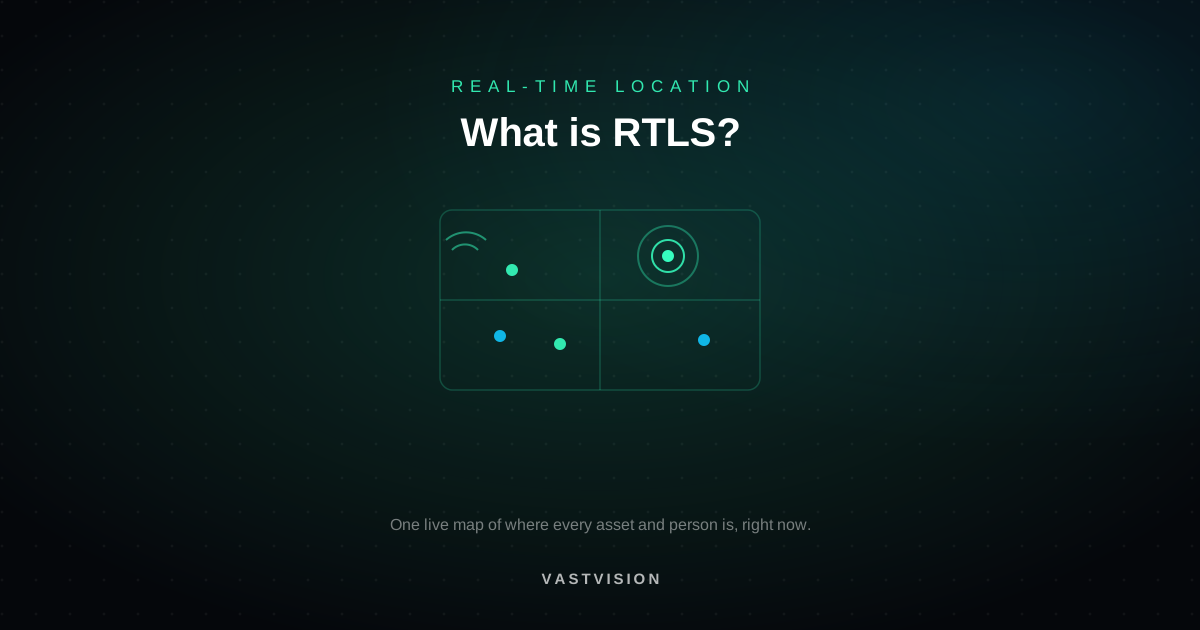
RTLS stands for Real-Time Location System. It is a system that continuously tracks where your assets and people are and shows it live, on a floor plan or map, as it happens. Not a barcode you scan, not a "last seen at the loading dock" event, but a constant, automatic picture of where everything is right now.
RTLS is the category term buyers reach for when zone-level tracking is not enough and spreadsheets have stopped working. This guide explains what an RTLS actually is, the technologies underneath it, how it differs from RFID, and how to choose the right one.
What does RTLS stand for?
RTLS is short for Real-Time Location System. The "real-time" part is the whole point: an RTLS does not wait for someone to scan an item or log a hand-off. It streams location automatically and continuously, so the map is always current.
How does an RTLS work?
Most real-time location systems share four building blocks:
- Tags: small devices attached to assets or worn by people. They broadcast a signal that identifies them.
- Fixed infrastructure: anchors, readers, or gateways mounted around the space that detect those signals.
- A location engine: software that turns raw signal data into a position, by measuring signal timing, angle, or strength.
- A platform: the maps, dashboards, alerts, and integrations where people actually use the location data.
The differences between RTLS products mostly come down to which radio the tags and infrastructure use, and that choice drives accuracy, range, battery life, and cost.
RTLS is not one technology
This is the most common point of confusion. RTLS is a category, not a single technology. A well-designed system picks the right radio for each job:
- Ultra-wideband (UWB) for centimeter-level indoor precision, a live dot on a floor plan.
- RFID for fast, low-cost bulk identification at doorways and choke points.
- Bluetooth (BLE) for inexpensive, low-power, zone-level proximity.
- LoRaWAN for long-range, low-power tracking across yards, campuses, and outdoor sites.
The strongest systems combine several of these rather than betting everything on one. That is the core idea behind end-to-end asset visibility.
RTLS vs RFID: what is the difference?
People often ask whether they need RTLS or RFID, as if they are competitors. They are not on the same level. RFID is a building block; RTLS is the system. RFID answers "what passed this reader, and when." An RTLS answers "where is everything, right now," and it may use RFID as one of its inputs alongside UWB, BLE, or LoRaWAN. If all you need is to log items as they cross a threshold, RFID alone may be enough. If you need continuous location and a live map, you need an RTLS.
What is RTLS used for?
- Healthcare: the largest RTLS market. Hospitals use it to locate mobile equipment in seconds, streamline workflows, and improve staff safety. See our hospital asset tracking buyer's guide.
- Manufacturing: tracking work-in-progress, tools, and vehicles across the plant floor.
- Warehousing and logistics: locating inventory, forklifts, and high-value assets in real time.
- Defense and government: precise accountability for equipment and personnel. See military and defense asset tracking.
How to choose an RTLS
Start from the outcome, not the radio. Ask:
- How precise do you need to be? Room-level, or shelf-level? That alone often decides between BLE and UWB.
- Indoors, outdoors, or both? Wide outdoor coverage points to LoRaWAN; dense indoor precision points to UWB.
- How many assets, and what battery life? Thousands of low-cost tags for years favors different radios than a few high-value assets updated many times per second.
- What does it need to connect to? A location system is only useful if it feeds your existing software and workflows.
Because the honest answer is usually a blend, the most important decision is choosing a partner who can deploy and unify more than one technology, not just resell a single one.
How VastVision delivers RTLS
VastVision designs, builds, and deploys real-time location systems end to end. We unify UWB, RFID, BLE, and LoRaWAN into one platform and one operational view, so each asset is tracked with the right technology and everything shows up on a single map. That is the difference between a pile of point products and a system. Explore high-precision indoor asset tracking and end-to-end asset visibility, then talk to our team to scope an RTLS for your operation.