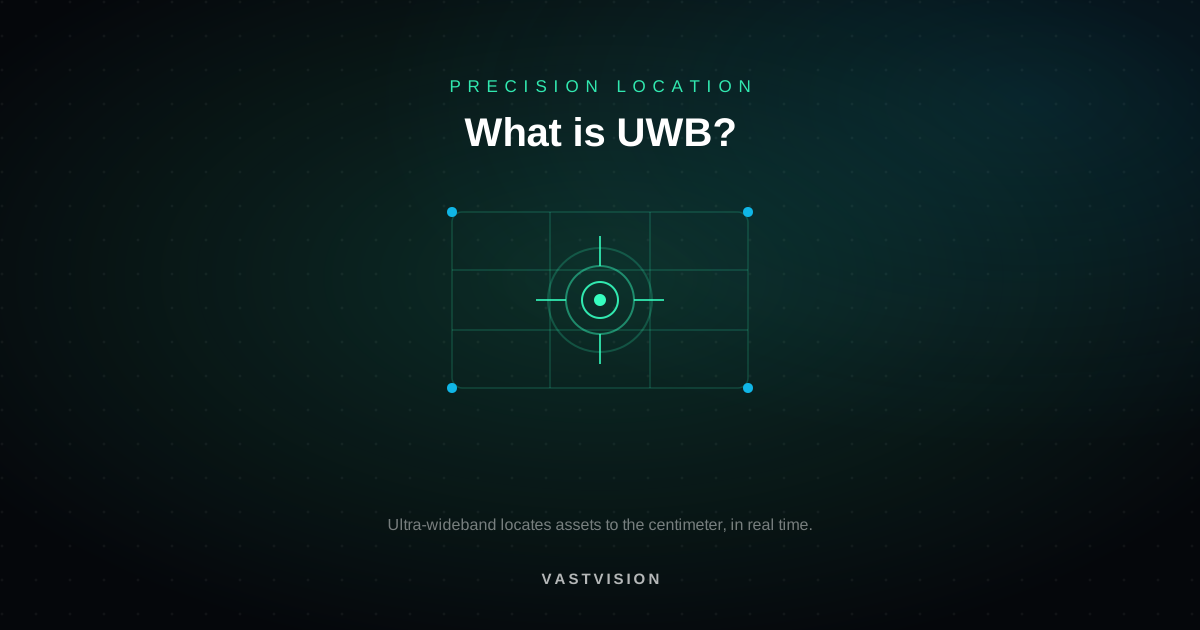
UWB stands for Ultra-Wideband. It is a short-range radio technology that locates tagged assets and people to within a few centimeters, in real time. Where most tracking tells you roughly which zone something is in, UWB gives you a live, precise dot on a floor plan.
If you have ever lost twenty minutes hunting for a piece of equipment that was in the building the whole time, that gap between "somewhere on this floor" and "right there" is the problem ultra-wideband solves. This guide explains what UWB is, how it works, how accurate it really is, and where it fits alongside other tracking technologies.
What does UWB stand for?
UWB is short for Ultra-Wideband. The name describes how the radio works: instead of sending signals on a narrow slice of spectrum like Wi-Fi or Bluetooth, UWB spreads very short pulses across a wide band of frequencies. Those sharp, precisely timed pulses are what make it so good at measuring distance, and therefore location.
What is UWB and how does it work?
A UWB positioning system has two core parts:
- Anchors: small fixed devices mounted around a space, on walls or ceilings. Together they form a known coordinate grid.
- Tags: lightweight devices attached to the assets or worn by the people you want to locate. Each tag exchanges short radio pulses with the anchors.
The system measures how long those pulses take to travel between a tag and each anchor, a technique called time-of-flight. Because radio waves move at a constant, known speed, a precise time measurement converts directly into a precise distance. With distances to several anchors, the system triangulates the tag's exact position and updates it continuously. For a deeper walkthrough, see how ultra-wideband positioning works.
How accurate is UWB?
UWB typically locates a tag to within roughly 10 to 30 centimeters, close enough to tell you which shelf, bay, or bed an asset is at, not just which room. That precision comes from those wide, sharply defined pulses, which let the system reject echoes and reflections that would confuse a narrowband signal. In practical terms, UWB is the difference between "the infusion pump is on the third floor" and "the infusion pump is in bay 4 of the east wing."
UWB vs RFID vs Bluetooth
These technologies are often compared, but they answer different questions:
- RFID is built for fast, bulk identification. A reader at a doorway or choke point can capture hundreds of tags per second as they pass. It tells you what went by and when, not exactly where something is sitting right now.
- Bluetooth (BLE) is low-cost and low-power, and gives you zone-level or proximity location, which room or which general area, but not a precise position.
- UWB gives you continuous, centimeter-level position, a live dot on a map. It costs more per point of infrastructure than BLE, so you use it where precision actually matters.
The right answer is usually not one technology but the right mix, which is exactly what a real-time location system (RTLS) coordinates.
What is UWB used for?
You may already carry UWB: it is the technology behind precise item finders and the "point to unlock" features in recent phones and cars. In industrial and enterprise settings, it powers:
- Healthcare: finding infusion pumps, wheelchairs, and portable monitors in seconds, and tracking staff safety. See our hospital asset tracking buyer's guide.
- Warehousing and manufacturing: locating high-value tools, WIP, and forklifts on a live floor plan.
- Labs and cleanrooms: tracking sensitive, expensive, or regulated equipment.
- Defense: precise accountability for gear and personnel. See military and defense asset tracking.
What UWB is not good for
Every technology has a tradeoff. UWB is a short-range, precision technology, so it is not the tool for covering miles of open yard or blanketing an entire town. That is a job for LoRaWAN, which trades precision for long range and years of battery life. And when you simply need to identify large volumes of items quickly and cheaply as they move through a gate, RFID is the better fit. The point is to match the radio to the job.
How VastVision uses UWB
At VastVision, UWB is one layer of a single platform. We combine it with RFID for fast identification and LoRaWAN for long-range coverage, so every asset is tracked with the right technology instead of forcing everything onto one. The result is real-time, centimeter-level visibility where you need it and wide-area coverage where you do not, all in one operational view. Explore our ultra-wideband technology page and our high-precision indoor asset tracking solution, then talk to our team to scope a deployment for your space.